 49's Team
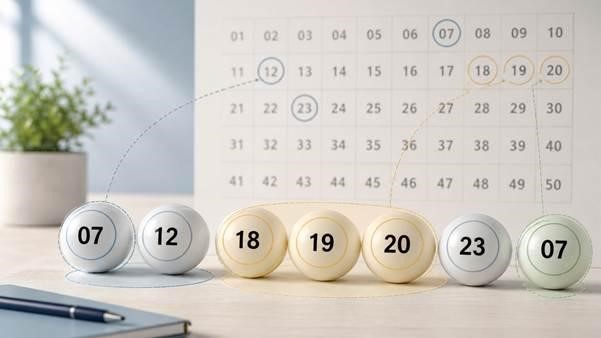
Random numbers can look tidy after they have already happened. A draw history might show a number appearing twice, a long gap beside another number, or a cluster sitting close together. The reader sees a shape, and then the brain starts supplying a reason. For readers who like carefully comparing past results, that is the useful tension: randomness often creates the streaks and clumps that people mistake for hidden structure.
Pattern reading feels natural because human attention connects details quickly. Research on randomness perception shows that people often judge sequences by how “random-looking” they feel, not only by the process that produced them, which is why open-access psychology research on randomness perception is useful background. A balanced view keeps two things separate: a pattern can be real, while still saying nothing certain about the next result.
How Reveal Speed Changes the Pattern
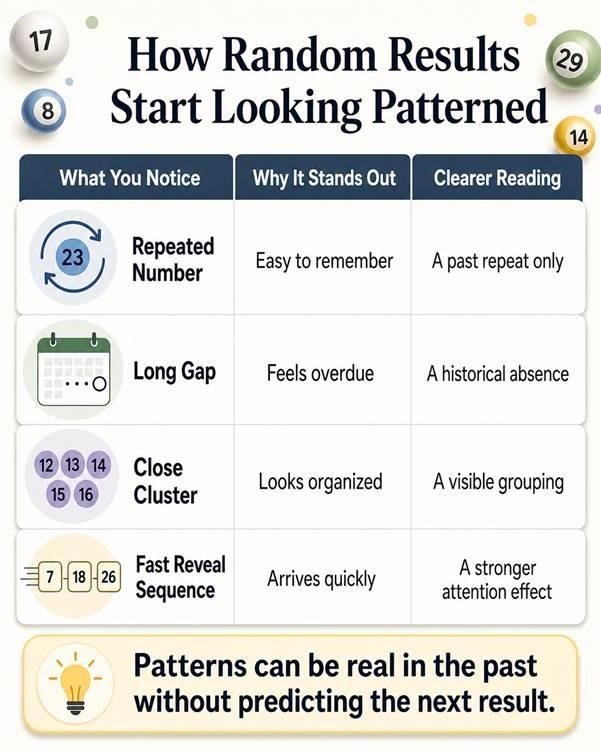
The way a result appears can make patterns feel stronger or softer. A scheduled lottery draw arrives as one complete event: the numbers are released together, and then readers compare them with previous draws.
A faster digital reveal works differently because attention lands on each symbol, panel, or result in a shorter rhythm. That is why a selection of scratch cards online can be a helpful comparison when thinking about random number patterns in lottery results. The format gives readers a simple yet subtle way to notice how the reveal speed changes perception without turning the idea into a prediction method.
In a draw history, the mind may focus on repeats across days or weeks. In scratch cards online, the mind may notice tiny runs because each reveal is closer to the next. Both examples point to the same lesson: a quick sequence can feel more meaningful because it is easier to hold in short-term memory, but that feeling is not the same as evidence.
Hot and Cold Numbers Are Descriptions
“Hot” and “cold” numbers are popular because they give the draw history a vocabulary. A hot number usually means a number has appeared more often in a recent sample. A cold number usually means it has appeared less often. Those labels can be useful for discussing past results, but they should stay in the past-tense lane.
A simple table helps keep the language clean:
| Term | What it describes | Clearer way to read it |
| Hot number | More frequent recent appearances | Notable in the sample viewed |
| Cold number | Fewer recent appearances | Less visible in the sample viewed |
| Cluster | Numbers grouped close together | A shape inside one result or run |
| Gap | Time since a number appeared | A historical absence, not pressure |
This matters because short samples are naturally uneven. If 6 numbers are drawn repeatedly, some will look busier than others for a while. That unevenness is not a flaw in randomness. It is one reason randomness feels textured.
What Results Pages Can Actually Teach
Historical pages are most valuable when they help readers slow down and describe what happened. They can show repeats, spreads, high-low balance, odd-even balance, and how often certain ranges appeared across a visible period. That turns a quick glance into a more careful reading of the record.
A reader looking through prediction discussions, for instance, can keep the same distinction in mind. Number commentary may be interesting, but a good reading habit separates observation from certainty. “Number 31 appeared several times in this period” is an observation. “Number 31 is now ready to appear again” adds a story that the data does not prove.
The strongest number readers are often the calmest ones. They notice the shape without needing it to carry more meaning than it can hold. They can enjoy the curiosity of a repeated ball, a neat spread, or a surprising cluster while remembering that each fresh result deserves to be read as its own event.
A Calmer Way to Read Randomness
The most useful mindset is not “ignore every pattern.” It is “name the pattern accurately.” If a result looks unusual, describe exactly what is visible. Did two numbers repeat from a recent draw? Did several numbers land in the same range? Did a long-absent number return? Good descriptions remove exaggerated meaning.
This is also where pacing helps. A draw history can invite constant scanning. A better rhythm is to pause, read once, compare with a sensible window, and then let the record stand. The pause does not make the numbers more random. It makes the reader less likely to confuse a striking sequence with a message.
Random numbers start looking patterned because humans have interesting biases when it comes to randomness. That can be useful, but it works best when paired with restraint. Lottery histories can be interesting and memorable without becoming predictive maps. The clearest reading is also the most relaxed one: notice the streak, name the cluster, and understand the gap.




Add comment